This guide answers the two questions that come up most often when choosing windows on the Costa del Sol: whether PVC warps in the heat, and whether aluminium copes with salt air. It sets out what EN 12608 and Qualicoat Seaside actually require, compares the two materials on insulation, maintenance and durability, and explains where each one makes sense.
In this article
Anyone replacing the windows of a house on the Costa del Sol ends up facing the same two doubts. The first usually arrives through a neighbour's comment or a forum thread: do PVC windows warp in the sun? The second turns up the moment you see a railing pitted by salt: does aluminium really last a few metres from the sea?
Both questions have an answer, and neither is a flat yes or no.
Does PVC warp in the sun? A quality PVC profile made for a severe climate, reinforced as the manufacturer specifies and properly installed, does not warp in the Málaga sun. What it does do is expand, considerably more than aluminium, and that movement is built into the design of the system. The real problems appear in specific situations: dark colours without the right technology, large sashes with too little reinforcement, or an installation that leaves the profile no room to move.
Does aluminium corrode by the sea? Aluminium does not rust the way iron does, but sea air certainly attacks it, mainly along two routes: galvanic corrosion, where it meets fixings made of another metal, and filiform corrosion, which creeps along underneath the paint. Both are avoided through specification decisions worth insisting on in writing: stainless steel fixings isolated from the profile, and a powder coating with Qualicoat Seaside approval or anodising of adequate thickness.
From here on, the detail: why each of these happens, what the standards say, and when one material makes more sense than the other.
Do PVC windows warp in the sun?
First, the numbers: how hot it gets on the Costa del Sol
Talking about the Málaga sun in the abstract does not help much, so here are the figures. According to AEMET's climate normals for the Málaga Airport station (1981-2010 period):
- 2,905 hours of sunshine a year.
- 30.8 °C average daily maximum in August and 30.5 °C in July.
- 65 % average annual relative humidity.
On top of that comes the terral, the hot dry wind that drops down to the coast from inland. During a terral, that same station recorded 44.2 °C on 19 July 2023.
For a window, though, the figure that matters is not the air temperature but the temperature of the profile itself. A surface in direct sun gets far hotter than the air around it, and the darker it is, the hotter it gets.
How much a PVC profile actually expands
Every material expands when it heats up. The rigid PVC used in windows does so more than metals: its coefficient of linear expansion is around 0.06-0.08 mm per metre per degree. Aluminium comes in at roughly 0.024 mm per metre per degree, which is between two and a half and three times less.
Put that in window terms: if a 2-metre profile goes from a summer dawn to mid-afternoon in direct sun and its temperature climbs by 30 °C, the PVC grows between 3.6 and 4.8 mm. An aluminium profile of the same length would grow about 1.4 mm.
Those millimetres are not a defect, just physics, and the movement is reversible: as the profile cools it returns to its original size. Any serious PVC system is designed around that. The trouble starts when someone ignores it, whether in the choice of colour, the reinforcement or the installation.
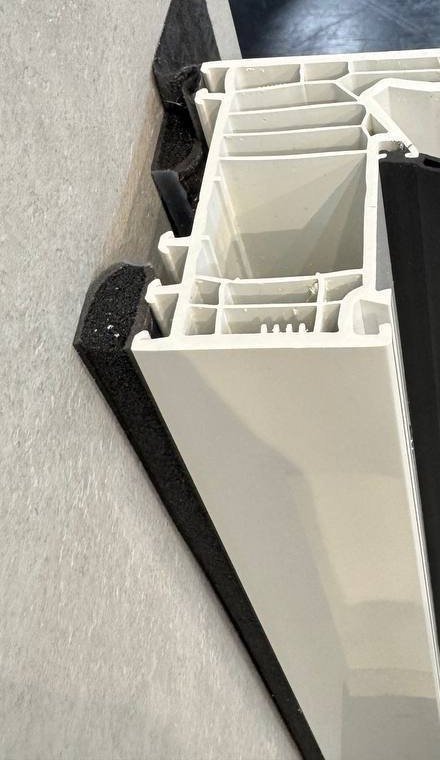
Where the standard draws the line: a Vicat temperature of 75 °C
The European standard for PVC window profiles, EN 12608, requires the material to have a Vicat softening temperature of at least 75 °C (method B50). That is the temperature at which a standard needle, under a 50 N load and with heating of 50 °C per hour, penetrates 1 mm into the material.
This is nowhere near the temperature at which a window melts. It is a technical marker for the point at which the plastic starts to lose stiffness. A white profile in the sun stays comfortably below it. A dark surface under the August sun can get a good deal closer, which is why dark colours come with rules of their own.
The same standard classifies profiles by weathering resistance into two climatic zones: M (moderate climate) and S (severe climate). The moderate zone covers places with less than 5 GJ/m² of annual solar radiation on a horizontal surface. The Costa del Sol is well past that threshold, so the sensible thing here is to insist on class S profiles.
White against dark colours: where the risk starts
Colour is the variable that changes how PVC behaves in the sun the most. To measure how much radiation a surface reflects, part 2 of the standard (EN 12608-2, which covers foiled profiles) uses two references: a white PVC panel with a solar direct reflectance of 73 % or more and a black one at 5 % or less. The gap between those extremes explains why a white profile and a black one, side by side, can sit at very different temperatures.
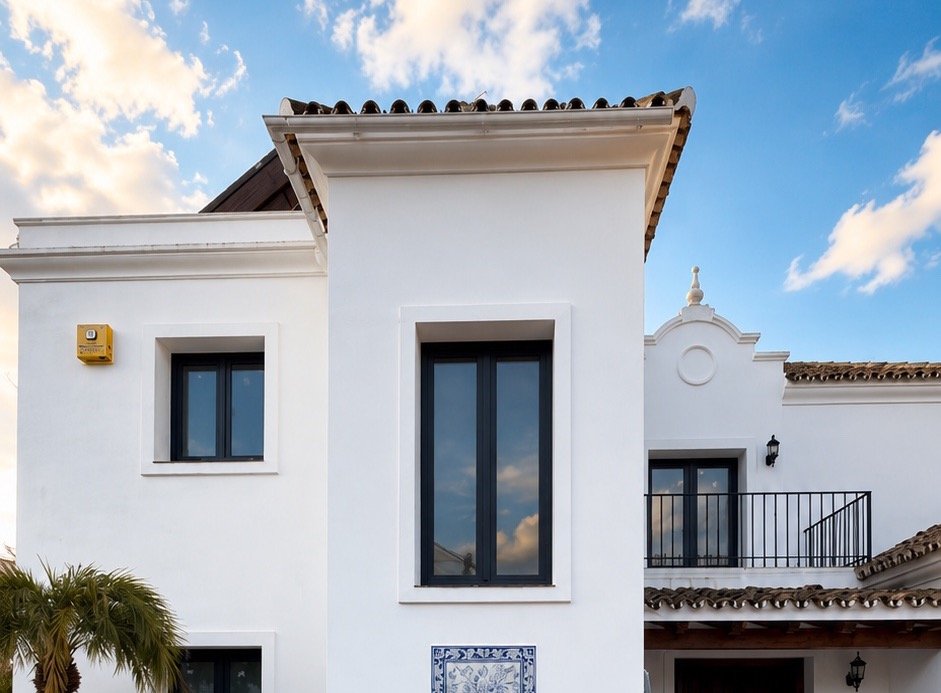
For the decorative foils that give PVC its colour, the standard notes that solar reflectance is usually above 20 %, and that foils below that figure should only be used in line with the profile supplier's recommendations.
A dark colour in the sun has two effects:
- More expansion, because the profile reaches a higher temperature.
- The so-called bimetallic effect. The outer face, out in the sun, gets much hotter than the inner one, which sits at room temperature. One face grows more than the other and the sash tends to bow slightly. It is the same principle as the bimetallic strip in a thermostat.
This is why system manufacturers publish specific rules for dark colours: which foils are allowed, what reinforcement is compulsory, and what maximum sash dimensions are permitted in each case.
What manufacturers do to keep the profile in shape
Internal metal reinforcement. The chambers of PVC profiles carry galvanised steel reinforcement inside, with the type and thickness chosen according to the size of the sash, its weight and its colour. The reinforcement adds stiffness against bending, wind load and the bimetallic effect. It is worth not overrating it: it reduces the expansion of the assembly only slightly, it does not remove it. Its main job is to keep the profile's shape.
A formulation for severe climates. Class S profiles are tested to withstand the ultraviolet radiation of sunny regions without losing either their properties or their colour.
Foils with infrared-reflecting pigments. Part of the sun's heat arrives as infrared radiation, which we cannot see. Some coloured foils carry pigments that reflect it even though the colour stays dark. According to figures published by VEKA for foils of this type, these pigments reflect up to 80 % of near-infrared radiation and cut the heating of the surface by as much as 15 °C.
Installation clearances. A perimeter joint has to be left between the window and the structure to absorb expansion, and the fixings must allow that movement. On dark profiles, the recommended clearances are larger.
Myth and real problem: how to tell them apart
The myth: PVC bows in the sun and after a few years the windows will not close. With a white or light class S profile, reinforced to the manufacturer's tables and installed with its clearances, this does not happen. Much of that reputation comes from older generations of profile and from cheap, uncertified products.
The real problem does exist, but it has specific causes:
- Dark colours with foils that have no reflective technology, on south- and west-facing elevations.
- Large sashes, sliding units above all, reinforced below what the system requires.
- Rigid installations: fixings with no clearance, or polyurethane foam pressing against the frame.
- Profiles that do not comply with EN 12608, or that are formulated for a moderate climate.
The classic symptoms are a sash that catches when you close it in mid-afternoon and closes perfectly in the morning, gaskets that no longer seat evenly, or a handle that is stiff during the hottest hours. If the problem comes and goes with the temperature, you are looking at thermal movement, not at a material that has failed. Even so, it is worth checking: repeated cycles put strain on the welded corners and the hardware.
Does aluminium corrode by the sea?
Why aluminium does not rust the way iron does
In contact with air, aluminium naturally forms a film of aluminium oxide only a few nanometres thick. Unlike iron oxide, which is porous and flakes away, this layer is dense, it protects the metal underneath and it repairs itself if scratched.
On the coast, the problem is chlorides. The salt carried by the sea breeze breaks that film at specific points and causes pitting corrosion: small craters with a whitish powder around them. Unprotected aluminium degrades this way in a marine environment. ISO 9223, the standard that classifies atmospheric corrosivity, places coastal areas with salt deposition in its highest categories.
This is why aluminium in a window on the coast must always carry a protective finish. And even with a good finish, there are two corrosion mechanisms worth understanding.
Galvanic corrosion: when the screw is to blame
Galvanic corrosion appears when three conditions come together:
- Two different metals in electrical contact, an aluminium profile and a steel screw, for instance.
- An electrolyte, in other words moisture with dissolved salts. On the coast, the film of salt on the surfaces does that job by itself.
- A potential difference between the two metals.
A small cell then forms, and the less noble metal dissolves for the benefit of the nobler one. In that pairing, aluminium usually loses out to carbon steel, stainless steel, copper or brass.
How serious it gets depends on the potential difference between the metals, how long the joint stays wet and the ratio between their surface areas. The coast makes the second factor worse: deposited salt draws moisture from the air and keeps the joint wet far longer than it would be inland.
Where it shows up: screws fixing the window to the structure, anchors, rivets, hardware, contact with steel sub-frames, and run-off water carrying copper ions from sills or downpipes.
How to avoid it:
- Fixings in A4 stainless steel (AISI 316), which thanks to its molybdenum content resists chlorides better than A2 (AISI 304).
- Electrical separation between screw and profile, using insulating washers or sleeves in nylon or EPDM, or purpose-made pastes.
- Never use zinc-plated or bichromated steel screws in contact with aluminium on the coast.
- Keep aluminium out of direct contact with copper and brass.
Filiform corrosion: the enemy that travels under the paint
This is the sneakiest of the two, because it starts where you cannot see it. It shows up as fine filaments, like threads or spider's legs, running underneath the coating and lifting it. It begins wherever the paint layer has a discontinuity: cut edges, drilled holes, mitres or scratches. Its ideal conditions are warm, humid and salty, which describes the Mediterranean coast precisely.
The key to filiform corrosion is not the paint but what lies beneath it. If the aluminium surface has not been thoroughly prepared before coating, the finish can look perfect on day one and fail years later. That is where the Seaside approval comes from.
Qualicoat Seaside: what it requires and why it matters on the Mediterranean coast
Qualicoat is the international quality label for architectural powder coating on aluminium. Within it, Seaside is an additional endorsement designed precisely for coastal locations and chloride-laden air. These are its requirements, according to the current Qualicoat specifications (2024 edition):
Deeper etching. Before coating, the aluminium goes through a chemical etch that removes a layer of its surface. Under the standard Qualicoat pretreatment, total etching has to be at least 1.0 g/m². For Seaside the requirement is at least 2.0 g/m², twice as much. Removing more material takes away the impurities that gather at the grain boundaries of the metal, which is exactly where filiform corrosion likes to travel.
The pre-anodising alternative. The coater can instead apply a thin anodic layer, between 4 and 10 microns, before the paint. This pretreatment earns the Seaside endorsement automatically.
Regular filiform corrosion testing. Coaters holding the Seaside endorsement undergo routine checks on finished products to ISO 4623-2. The samples are scratched, exposed to hydrochloric acid and then kept for 1,000 hours at 40 °C and 82 % relative humidity. To pass, the longest filament may not exceed 4 mm and the average length 2 mm.
To that you can add the general Qualicoat requirements for any coating: a minimum thickness of 60 microns for class 1 and 2 powder coatings (50 microns in class 3) and resistance to 1,000 hours of acetic acid salt spray (2,000 hours in class 3).
One practical detail heads off a lot of misunderstandings: Seaside certifies the coater, not the paint. A Qualicoat-approved powder applied in a workshop without that endorsement does not carry the same guarantee. What you need to ask for is the coater's certificate with the Seaside endorsement in force.
Anodising: protection without paint
Anodising is the other way of protecting aluminium. Instead of applying a layer on top, an electrochemical process grows the metal's own oxide layer in a controlled way, and it is then sealed. The protection is part of the aluminium and cannot peel off the way paint can.
The reference label here is Qualanod, which grades anodising by minimum thickness. For aggressive environments, marine or industrial, the grades used are class 20 and class 25, with minimum thicknesses of 20 and 25 microns respectively.
It has its limits: the range of finishes is narrower than with powder coating (silvers, bronzes, blacks), and a deep scratch cannot be touched up as easily.
PVC and aluminium head to head in a coastal climate
Thermal insulation and energy efficiency
Here the physics is unambiguous. According to the reference values in EN ISO 10077-2, the thermal conductivity of PVC is 0.17 W/(m·K) and that of aluminium 160 W/(m·K). Aluminium conducts heat almost a thousand times better than PVC.
That is why a modern aluminium window needs a thermal break: strips of glass-fibre reinforced polyamide, with a conductivity of 0.30 W/(m·K), separating the outer part of the profile from the inner one and interrupting the path of the heat. Without a thermal break, an aluminium frame is a thermal bridge; with one, the system is a different proposition altogether.
PVC insulates by nature, and its multi-chamber profiles reinforce that effect. Like for like, a PVC frame usually insulates better than an aluminium one. High-end aluminium systems with a thermal break narrow that gap considerably.
As for the regulations, the city of Málaga sits in climate zone A3 of Spain's building code, the Código Técnico de la Edificación, and the transmittance limit for windows in zone A is 2.70 W/(m²·K). Good PVC and aluminium with a thermal break both meet that limit without difficulty. In a climate where the energy goes on cooling rather than heating, the glass (its solar factor and how it controls the sun) matters as much as the frame for summer comfort.
Behaviour in extreme heat and terral
PVC: it expands more and, in dark colours, needs the right foils, reinforcement and clearances. In white or light shades, the heat of the coast is not an issue.
Aluminium: it expands less, does not lose stiffness at the temperatures a window ever reaches, and copes better with dark colours on sun-drenched elevations. That does not mean it stays cool: an anthracite profile in the sun is too hot to touch, and without a good thermal break it passes that heat inside. So that colour and gloss survive intense sun, Qualicoat class 2 and class 3 coatings offer higher weathering resistance than class 1.
Humidity and salt air
PVC: the profile does not corrode. Salt air has no effect on the material itself, which is a genuine advantage on the front line. Its weak points are the metal components: the galvanised steel reinforcement, protected inside the profile, and above all the hardware.
Aluminium: it needs the right finish (Seaside, or class 20-25 anodising) and compatible fixings, as we have seen. Properly specified, it performs perfectly well in a marine environment.
In both cases, the weak link they share is the hardware: hinges, espagnolettes and locking points. EN 1670 grades their corrosion resistance, and the highest, grade 5, corresponds to 480 hours of salt spray testing. On the coast it makes sense to ask for it, whatever the profile is made of.
Maintenance and care
The routine is similar for both materials and reasonably simple:
- Rinse with fresh water and a neutral soap several times a year, more often on the front line. It barely rains in Málaga in summer, so salt builds up with nothing to wash it away. The sheltered areas under eaves and porches, where the rain never reaches, are the ones that collect the most.
- Clear the drainage slots in the frame so that water can get out.
- Check and lubricate the hardware with suitable products.
- Inspect the rubber gaskets, which age in the sun.
The specific differences: PVC takes neither abrasives nor solvents. Powder-coated aluminium should not meet abrasives either, and any scratch that reaches the metal is best touched up promptly, because it is an entry point for filiform corrosion. Anodising is cleaned with pH-neutral products.
Real service life on the coast
There is no honest single figure that covers every case, because durability on the coast depends more on the specification and the maintenance than on the material itself. White class S PVC with good hardware, and aluminium with a Seaside coating and A4 fixings, are both solutions built to last for decades.
Early failures almost always start with a shortcut: dark foils without adequate reflectance, skimped reinforcement, zinc-plated screws, a coater without the Seaside endorsement, or standard hardware on the beachfront.
Price
Broadly speaking, PVC is the more affordable option. Aluminium with a thermal break, a Seaside coating and highly corrosion-resistant hardware costs more, and the gap widens on large formats. Some of those large formats, though, are only viable in aluminium.
Comparison at a glance
| PVC | Aluminium with thermal break | |
|---|---|---|
| Thermal conductivity of the material | 0.17 W/(m·K) | 160 W/(m·K), offset by the thermal break |
| Thermal expansion | 0.06-0.08 mm/m·°C | ≈ 0.024 mm/m·°C |
| Behaviour with salt | The profile does not corrode | Needs a Seaside coating or class 20-25 anodising |
| Main risk on the coast | Badly specified dark colours | Incompatible fixings and filiform corrosion |
| Dark colours in the sun | With reflective foils, reinforcement and size limits | No structural limits |
| Large formats and slim sightlines | Limited | Its strong point |
| Maintenance | Cleaning with water and neutral soap | Cleaning plus touching up scratches |
| Relative price | More affordable | More expensive |
| What to insist on | Class S to EN 12608 | The coater's Qualicoat Seaside certificate |
PVC or aluminium? Where each one belongs
There is no universal winner. Each material has its own ground.
When PVC makes more sense
- When insulation is the priority and the budget is contained.
- In windows and balcony doors of medium size, where the reinforcement has an easy job.
- In white or light colours, or on elevations that see little afternoon sun.
- In beachfront properties, where the design allows it: the profile does not corrode and salt air does not affect the material. The hardware does need to be highly corrosion resistant.
- In homes where the aim is minimum maintenance and no dependence on the quality of a coating.
When aluminium makes more sense
- In large sliding and lift-and-slide units, with heavy, wide sashes that PVC either cannot handle or handles with a long list of limitations.
- When the brief calls for slim sightlines and the largest possible glazed area, which is standard practice in villas with sea views.
- In dark colours such as anthracite, on south- and west-facing elevations, where aluminium is free of the thermal constraints of PVC.
- In contemporary architecture that calls for continuity of finish with railings, pergolas or metal cladding.
- Whenever it is properly specified for the sea: a Seaside coating or class 20-25 anodising, a thermal break, and isolated A4 fixings.
The middle road: hybrid PVC-aluminium systems
There are systems that combine a PVC body, which provides the insulation, with an external aluminium shell, which provides visual crispness, colour and resistance to the sun. They can be a good answer when you want a dark exterior with the thermal performance of PVC. The aluminium part, mind you, is still exposed to the sea and needs exactly the same finish specification.
What to ask for in writing before you sign a quote
If it is PVC:
- Profiles compliant with EN 12608, class S (severe climate).
- Reinforcement to the manufacturer's tables for the size and colour of each sash.
- In dark colours, a foil with reflective pigments and confirmation that the dimensions fall within the system's limits.
- Installation clearances that are adequate, with fixings that allow for expansion.
If it is aluminium:
- The coater's Qualicoat certificate with a valid Seaside endorsement , or anodising to Qualanod class 20 or 25.
- Thermal break in the system.
- A4 stainless steel fixings , electrically separated from the profile.
In both cases:
- Grade 5 hardware for corrosion resistance to EN 1670.
- Maintenance instructions in writing, matched to the distance from the sea.